ConceptArt.org's forums often hold a Creature of the Week contest. Many of my older posts from a few years ago were typically revolved around these contests and I can certainly see how much I've developed from my posts back in 2012... It's been a couple years since I last entered though, and with the latest contest sounding as fun as it did I couldn't resist trying to see what I came up with.
This weeks topic was to redesign the Elder Dragon 'Bahamut' from the Final Fantasy series. Bahamut is typically shown as an almost anthropomorphized dragon, with an upright body and large wings. However, I wanted to try spending this time designing a more feral creature.

I started by trying to draw some very strange dragon shapes, adjusting proportions and wing spans. I had an image of a lumbering creature with huge wings and small arms originally.

Eventually I settled on the more typical draconian design, trying to keep the wings the main focus of this silhouette. However I seem realized that this was more wyrm-like, and not as large and bulky as I would have liked.

This design felt much more in line with what I had wanted. A nice reptiallian design, with a solid silhouette and line of action following through the body. The one issue I was worried about detailing however, was the wings. I had a rough copy but this was far from a nice version I could work details and perspective from.

I ended up building a very quick set of wings in Maya and taking several screen shots to make sure I had the angles right. With that down it was time to decide what the face of the dragon would be.

I tried your usual dragon style heads, as well as the more horror types, with beady eyes, or even not any eyes at all.

Now I had my sketch down, and my head designed I threw down some quick values to assign where the focus would be. From here on out it was simply tidying up and making this beast presentable.
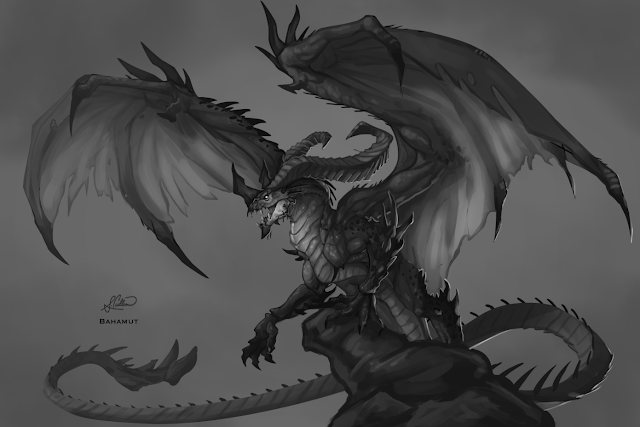

And there we have it. A final finished Bahamut Redesign.
 |
| Final Design |

I started by trying to draw some very strange dragon shapes, adjusting proportions and wing spans. I had an image of a lumbering creature with huge wings and small arms originally.

Eventually I settled on the more typical draconian design, trying to keep the wings the main focus of this silhouette. However I seem realized that this was more wyrm-like, and not as large and bulky as I would have liked.

This design felt much more in line with what I had wanted. A nice reptiallian design, with a solid silhouette and line of action following through the body. The one issue I was worried about detailing however, was the wings. I had a rough copy but this was far from a nice version I could work details and perspective from.

I ended up building a very quick set of wings in Maya and taking several screen shots to make sure I had the angles right. With that down it was time to decide what the face of the dragon would be.

I tried your usual dragon style heads, as well as the more horror types, with beady eyes, or even not any eyes at all.

Now I had my sketch down, and my head designed I threw down some quick values to assign where the focus would be. From here on out it was simply tidying up and making this beast presentable.


And there we have it. A final finished Bahamut Redesign.
Comments
Post a Comment